How to Send One Message to 20 Different Rooms at the Same Time?
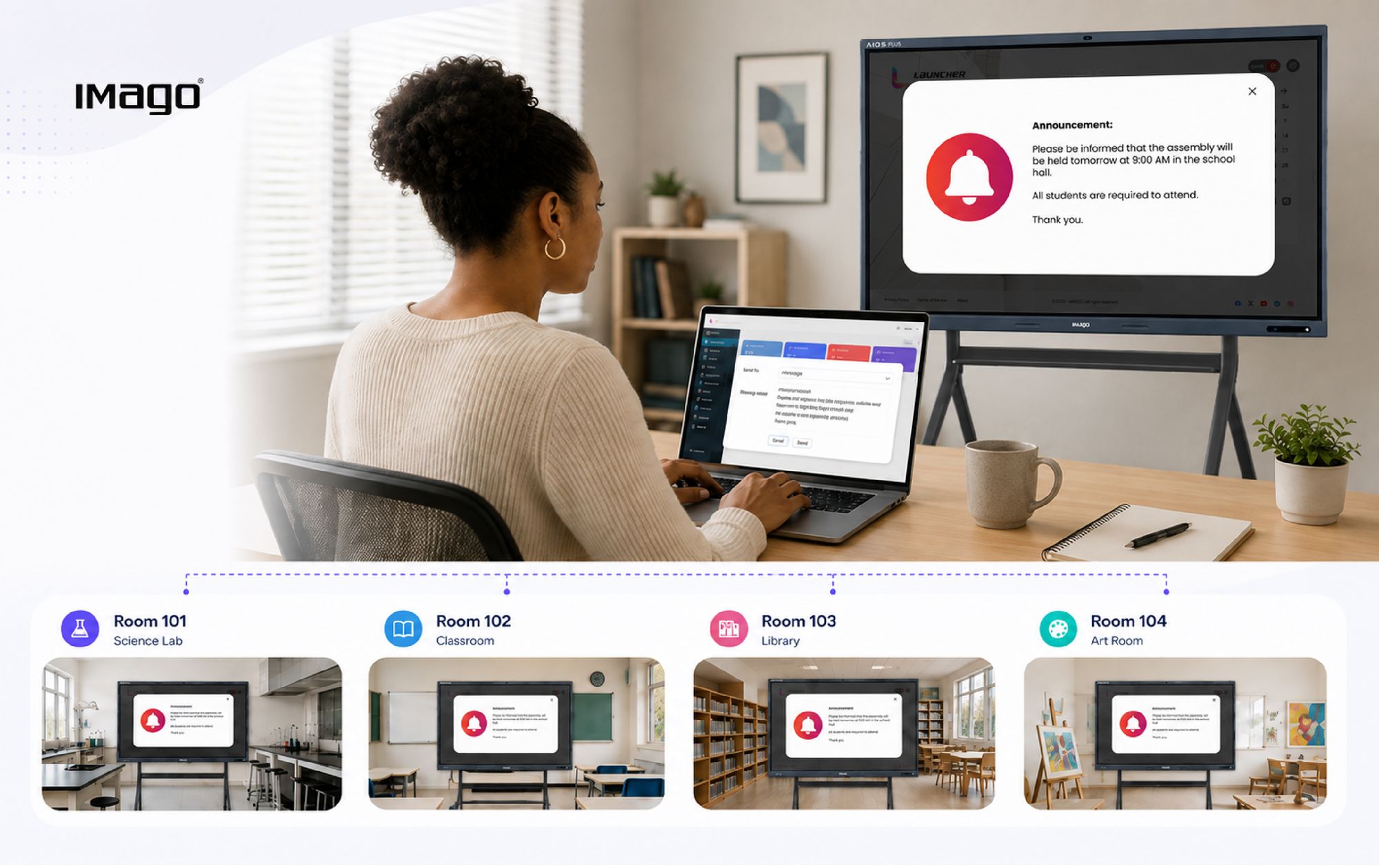
As organizations continue to adopt interactive smartboards across multiple rooms, managing these devices efficiently is becoming increasingly important. What starts as a single smart display can quickly grow into dozens—or even hundreds—of connected devices across classrooms, meeting rooms, training spaces, campuses, and facilities.
As these deployments scale, managing each device individually can become time-consuming, repetitive, and increasingly difficult to coordinate. Organizations need more than connected hardware; they need a smarter way to manage and control their growing network of devices from a central point.
This is where centralized device management becomes more than a convenience. It becomes an important part of managing a connected environment at scale.
🔍 What Is Centralized Device Management?
Centralized device management refers to the ability to manage multiple connected devices from a single central platform or point of control.
Instead of accessing each device individually, administrators can use a central management solution to perform supported actions across multiple connected devices.
The concept is simple:
Multiple devices → One management platform → Centralized control
This approach can help organizations reduce repetitive tasks, improve operational consistency, and simplify the management of large device deployments.
For organizations investing heavily in smart technology, device management is therefore an important consideration—not just the devices themselves.
🔍 Why Is Centralized Device Management Important?
Deploying smart technology across an organization can bring significant benefits. However, the larger the deployment becomes, the more challenging it can be to manage.
Consider an organization with 50 smartboards across different rooms.
If an administrator needs to perform the same action or communicate the same information across those devices, managing them individually could require repeating the same process 50 times.
This creates several challenges:
-More repetitive administrative work
-Increased time spent managing devices
-Greater risk of human error
-Difficulty coordinating multiple rooms
-Less efficient use of IT and administrative resources
Challenges when scaling device deployments
Centralized device management addresses this challenge by providing a single point of management for multiple connected devices.
Rather than treating every smartboard as an isolated device, organizations can manage their connected technology as part of a larger, centralized environment.
🔍 What Is IMAGO Proctor?
IMAGO Proctor is a centralized device management solution that enables organizations to manage and control multiple connected smartboards and devices from a single platform.
Rather than accessing each device individually, Proctor provides a central management environment for connected devices.
This allows organizations to take a more scalable approach to smartboard device management and multi-device operations.
At a high level, the concept is simple:
Multiple connected devices → One central platform → Centralized management
This can help organizations simplify daily operations and reduce the need for repetitive, device-by-device management.
Whether an organization is managing smartboards across several rooms or deploying connected devices across a larger facility, a centralized device management platform provides a more structured way to manage that technology.
🔍 One Message. Multiple Rooms.
One of the practical capabilities of IMAGO Proctor is its centralized messaging feature.
Let's take the earlier example.
You have the same message that needs to reach 20 different rooms.
Traditionally, someone may need to manually send that message to each room individually.
That means:
Room 1 → Send
Room 2 → Send
Room 3 → Send
Room 4 → Send
And so on.
With IMAGO Proctor, users can send one message to multiple connected smartboards across different rooms simultaneously.
The process is simple.
Type the message once, select the connected devices or rooms, and send.
The message can then be delivered to multiple connected smartboards at the same time.
One message. Multiple rooms. Simultaneous delivery.
What would otherwise require multiple individual actions can be handled through a single centralized action.
🔍 How Centralized Messaging Works
The concept behind Proctor's messaging capability is straightforward.
1. Create your message
Start by typing the information or instruction you want to communicate. There is no need to recreate the message for every room.
2. Send from a central platform
Use IMAGO Proctor to distribute the message to the relevant connected smartboards.
3. Reach multiple devices simultaneously
The message can be delivered to connected smartboards across different rooms at the same time.
This creates a more efficient communication workflow:
Type once → Send once → Reach multiple rooms
For organizations managing a large number of connected displays, removing repetitive steps can make everyday operations significantly more efficient.
🔍 Benefits of a Device Management Solution
A centralized device management platform isn't simply about convenience. It can support more efficient technology operations as organizations scale.
1. Reduce Repetitive Work
One of the biggest advantages of centralized device management is reducing repetitive tasks. When the same information needs to be sent to multiple devices, administrators don't need to repeat the process for every individual device.
This can free up valuable time for more important operational responsibilities.
2. Improve Operational Efficiency
Managing multiple devices from one central platform can simplify workflows. Instead of moving between different rooms or interacting with devices individually, administrators can perform supported management activities centrally.
This can make everyday smart device management more efficient.
3. Improve Communication Consistency
When the same message needs to reach multiple rooms, consistency is important. Centralized messaging allows the same communication to be distributed across connected smartboards, helping reduce the risk of different rooms receiving different versions of an instruction or announcement.
4. Support Scalability
The more devices an organization deploys, the more important efficient management becomes.
A device management solution provides a foundation for organizations to manage larger numbers of connected devices without relying entirely on manual processes.
5. Simplify Multi-Room Management
For organizations operating across multiple rooms, buildings, or facilities, centralized device management can provide a simpler way to manage connected technology.
Instead of viewing every smartboard as a separate device, administrators can manage connected devices through a central environment.
🔍 The Future of Smartboard and Device Management
As organizations continue investing in interactive displays and smart technology, device management will become an increasingly important consideration.
The conversation should no longer stop at:
“What features does this smartboard have?”
Organizations should also consider:
“How easily can we manage all of these devices once they're deployed?”
A smartboard can provide an excellent user experience in one room.
A device management solution helps organizations think about the experience across an entire network of rooms.
That distinction becomes particularly important for large-scale deployments. The future of smart technology isn't simply about adding more connected devices. It's about making those devices easier to manage, coordinate, and operate at scale.
Ready to simplify the way you manage your connected devices?
Contact us today to learn more about IMAGO Proctor and our smart solutions: https://imago.us/contact-us/