The End of Productivity Stack: Why One Workspace like Collab Is Enough
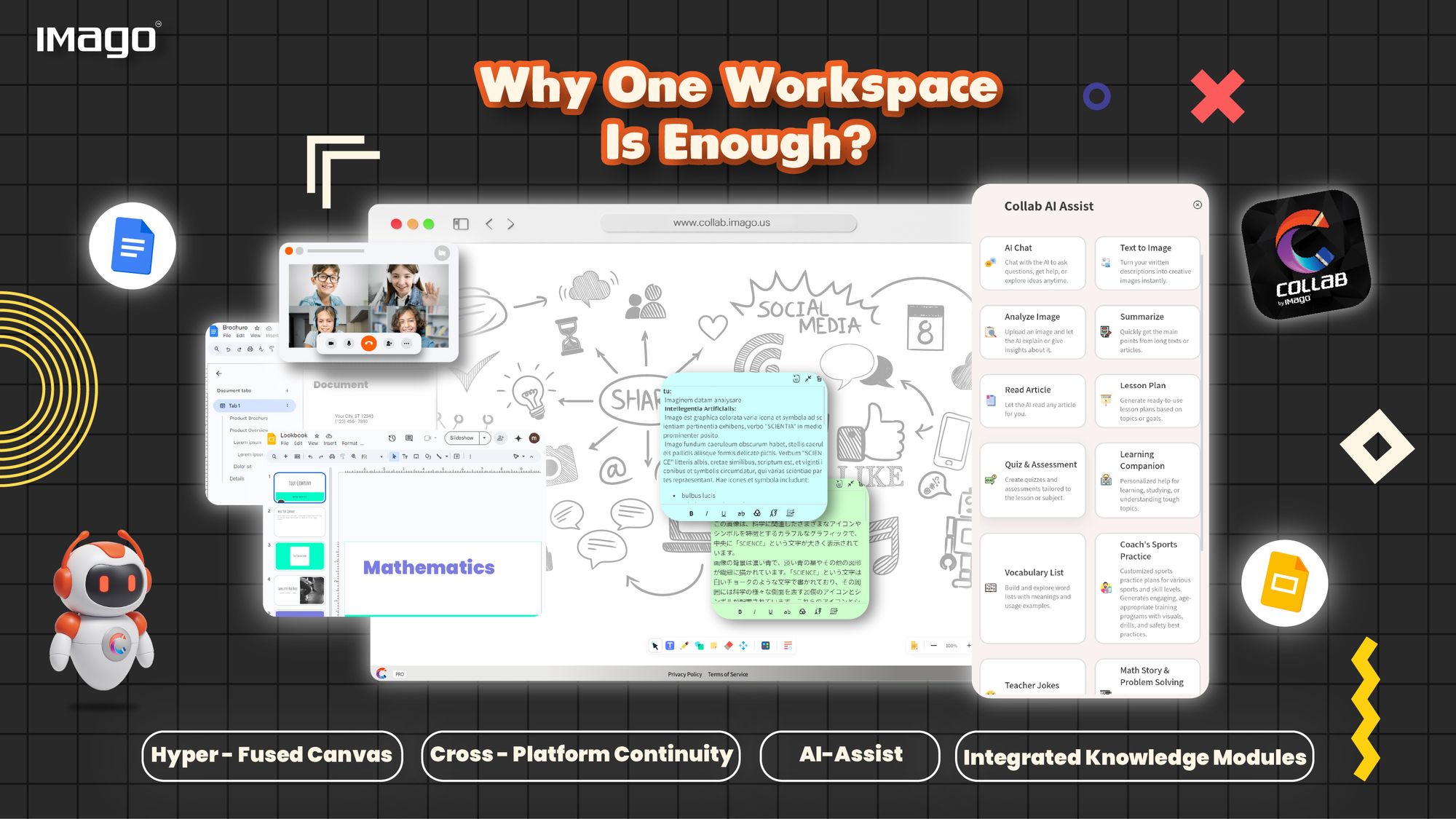
For years, organizations have attempted to improve efficiency by adding more tools to their productivity stack. While each application promises improvement, the combined result is often the opposite: fragmented workflows, duplicated information, and constant context switching. Today, a new approach is emerging. Instead of assembling complex stacks of disconnected apps, forward-thinking teams are moving toward a single, unified workspace. This shift marks the end of the traditional productivity stack and the rise of the Knowledge Operating System.
What Is Productivity Stack?
A productivity stack refers to the collection of software tools used to manage daily work typically including:
- Document editors
- Spreadsheet and presentation tools
- Task and project management platforms
- Whiteboards and brainstorming apps
- Knowledge bases and wikis
- Communication and meeting tools
While each tool may excel in isolation, they rarely work as one system. Information becomes scattered across platforms, forcing users to manually connect ideas, files, and decisions.
The Hidden Cost of Multiple Apps
1. Context Switching Reduces Productivity
Research consistently shows that switching between applications disrupts focus and slows execution. Every time users move between tools, they lose mental context resulting in errors, delays, and fatigue.
2. Fragmented Knowledge
When notes, tasks, documents, and discussions live in different systems, knowledge becomes difficult to retrieve and maintain. Teams often recreate work simply because they cannot find what already exists.
3. Collaboration Friction
Version conflicts, unclear ownership, and disconnected conversations are common in multi-tool environments. Teams spend more time coordinating than creating.
4. Security and Compliance Risks
Each additional platform introduces new data storage locations, access controls, and compliance considerations raising both cost and risk.
The Rise of the Knowledge Operating System
Traditional productivity tools are built around file types—documents, spreadsheets, presentations, or boards. While familiar, this structure forces work to be spread across multiple applications, breaking context and slowing decision-making.
A Knowledge Operating System takes a different approach. It is designed around how people think, plan, and act, not around rigid file formats.
In a Knowledge OS:
- Ideas, notes, data, visuals, and tasks live in one connected workspace
- Information can be organized and reorganized as work evolves
- Related concepts are linked, not duplicated
- Thinking, collaboration, and execution happen in the same environment
Rather than simply completing tasks, teams build a living knowledge system—one that captures decisions, context, and insights over time. This allows organizations to move faster, reduce rework, and retain knowledge instead of losing it across disconnected tools.
How Collab, the All-In-One Workspace Replaces the Productivity Stack
Collab is built as a software-first Knowledge Operating System designed to eliminate the need for multiple disconnected tools.
Hyper-Fused Canvas
Collab allows users to work within a single, block-based canvas that supports:
- Documents, tables, and spreadsheets
- Kanban boards and storyboards
- Mind maps and free-hand drawings
- Embedded files (Word, Excel, PowerPoint, PDFs, images)
Users can switch views without leaving the workspace, maintaining full context.
Integrated Knowledge Modules
Journals, wikis, tasks, calendars, and boards are not separate apps—they are interconnected components of one system.
AI-Assisted, Privacy-First Productivity
Collab’s dual-mode AI enhances drafting, summarisation, task extraction, and search—while keeping data under user control through local-first storage and encrypted sync.
Cross-Platform Continuity
Workspaces behave consistently across Windows, macOS, Linux, mobile devices, and tablets, ensuring uninterrupted workflows.
Work Doesn’t Need More Tools. It Needs One System.
The traditional productivity stack was built to solve isolated problems—documents, tasks, presentations, and collaboration. Over time, it has evolved into a fragmented ecosystem that slows work, obscures knowledge, and increases operational complexity. Modern organizations need more than another tool. They need a single, coherent workspace where thinking, collaboration, and execution happen together.
Collab was designed precisely for this shift. As a software-first Knowledge Operating System, Collab brings documents, data, visual thinking, and AI assistance into one continuous, privacy-first environment. Instead of managing multiple applications, teams work within a unified system that preserves context, reduces friction, and turns information into actionable knowledge.
The end of the productivity stack is not about doing less work, it is about working with greater clarity and intent. With Collab, one workspace is enough.