The Digital Evolution Playbook: How to Successfully Introduce New Workplace Technology without Killing Productivity
In 2026, your company is no longer defined just by the products it sells, but by the efficiency of the digital infrastructure that supports it. Every CEO and IT Director knows that a modern workplace requires continuous innovation. The challenge isn't finding powerful technology; it’s getting your human workforce to embrace it.
Failed digital transformation initiatives cost enterprises millions annually, not just in licensing fees, but in lost productivity due to employee resistance to new technology. When workers feel overwhelmed by a "Frankenstein stack" of fragmented applications, they retreat to familiar, inefficient workflows. They continue context switching between ten different tabs, leaking valuable cognitive time.
A successful technology rollout isn't just an IT project; it's a strategic initiative. This is your playbook for turning a tool launch into a cultural revolution, featuring the latest insights on unified ecosystems.
How to Successfully Introduce New Workplace Technology
Phase 1: Preparation is the Architecture of Adoption
You cannot successfully introduce new technology if you are solving the wrong problem. Before you evaluate a single vendor, you must audit your existing "Integration Debt."
1. Identify point solution fatigue
Are your employees suffering from point solution fatigue? Count the number of logins an average employee needs to complete a single task. If they must chat in one app, document in a second, and track progress in a third, your workspace friction is too high. This constant context switching can destroy up to 40% of their productive time.
2. Choose an Ecosystem, Not a Tool
The most successful tech rollouts in 2026 focus on SaaS consolidation. Decision-makers are prioritizing an all-in-one ecosystem over point solutions. When you adopt a unified platform like IMAGO, you aren’t asking employees to learn five new interfaces; you are offering them one source of truth that simplifies their day.
Phase 2: Building the Social Contract
You cannot force digital transformation; you must invite your team into it. Addressing the psychological aspect of change is mandatory.
3. Communicate the "Why" (The Value Proposition)
Don't announce features. Announce solutions. Instead of saying, "We are launching a new platform with AI capability," say, "We are introducing a unified workspace that will automate your administrative busywork, freeing you up for creative strategy." Focus on how the new workplace collaboration tools will improve their daily quality of work life.
4. Create "Tech Champions"
A top-down mandate often fails. Identify early adopters across different departments—not just in IT—to be your "Tech Champions." Train them first, making them power users. They will provide authentic peer-to-peer training and mitigate resistance by demonstrating success within their own workflows.
Phase 3: Frictionless Implementation
When it's time to launch, focus on minimizing the "Time-to-Value." The initial experience will dictate long-term adoption rates.
5. Prioritize Intuitive Design
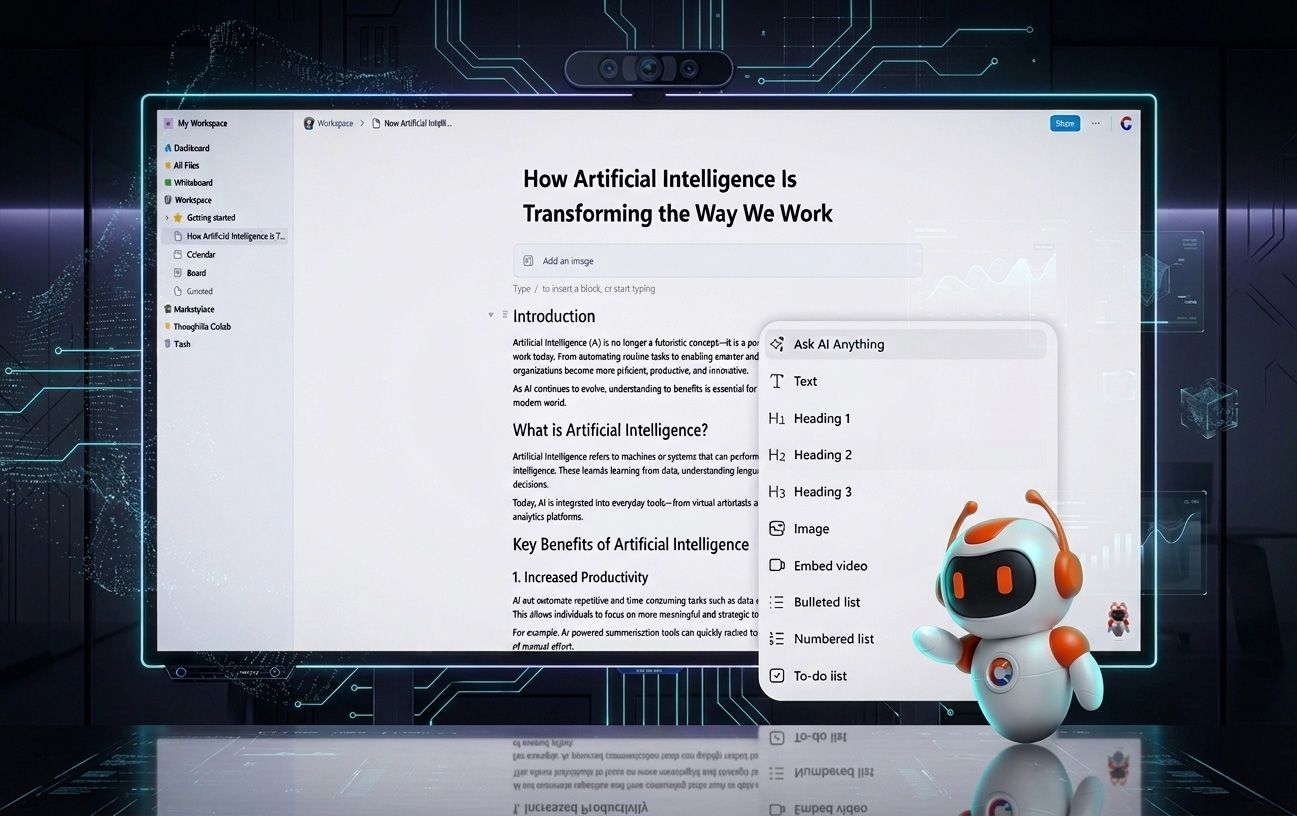
If your team needs a five-day training workshop to understand the platform, it is too complex for 2026 standards. The best modern workplace technologies require little training because their design is familiar. This is where a block-based editor excels—it utilizes intuitive drag-and-drop components that employees can master in minutes.
6. Introduce "Active AI," not "Passive Chat"
Many digital adoption plans stall because the AI integrated into the new tools is "generic"—it can only summarize text or write emails (which many employees are already doing with standalone tools).
To drive true excitement, introduce Agentic AI. Show your employees how embedded agents can actually execute tasks based on the data within the workspace—such as converting meeting notes directly into a tracked project timeline or a client proposal block. This tangible time-saving creates an immediate "aha!" moment that cements adoption.
Enterprise Edge: IMAGO’s Agentic AI isn't a passive chatbot sitting in a sidebar. It is embedded directly into the all-in-one ecosystem. Our AI agents can "read" your dynamic block documents
Phase 4: Sustainable Scaling
The launch is day one. The true success of new workplace technology is measured in months six through twelve.
7. Mandate a "Single Source of Truth"
Once the transition period ends, retire the old, fragmented tools. If your team is allowed to keep using personal WhatsApp groups or old spreadsheet trackers, they will. By making the new unified ecosystem the mandated "digital headquarters," you enforce the cultural shift.
8. Collect Feedback and Optimize
Establish clear channels for employees to report friction. Modern collaboration platforms should allow you to customize workflows continuously. Successful companies view their digital workspace not as static software, but as a living ecosystem that adapts to how their teams work.
Conclusion: The Path Forward
The successful introduction of new workplace technology requires a strategic alignment of people, processes, and a unified platform. Resistance is natural, but it is manageable when employees see that the new tool is an asset that reduces friction rather than increasing their workload.
If you are ready to eliminate point solution fatigue and move toward a true all-in-one ecosystem that leverages the latest in AI tech and block-based editing, we invite you to explore IMAGO COLLAB. We don’t just build software; we architect the future of focus.