The AI Privacy Shift Nobody Is Talking About
Artificial intelligence is now embedded in how we teach, work, and create. From lesson planning and research to reporting and collaboration, AI has become an everyday productivity layer. Yet as adoption accelerates, one critical issue remains largely overlooked: AI privacy.
Most AI tools today are built on a single assumption — that data must be sent to the cloud to be processed. This cloud-first model has enabled rapid innovation, but it has also introduced serious concerns around data ownership, compliance, confidentiality, and long-term control. Quietly, a shift is underway. Forward-thinking organizations are beginning to ask a different question: What if AI didn’t always need the cloud?
This is the AI privacy shift nobody is talking about, and it will define the next generation of intelligent workspaces.
Why AI Privacy Matters More Than Ever
When AI runs in the cloud:
- Your documents are sent to external servers
- Sensitive information is handled by third parties
- Internet access is always required
For schools, businesses, and knowledge workers, this can be a concern. Lesson plans, student data, internal notes, and private documents should not always leave the user’s device.
This is where a quiet shift is happening.
The Rise of Dual-Mode AI
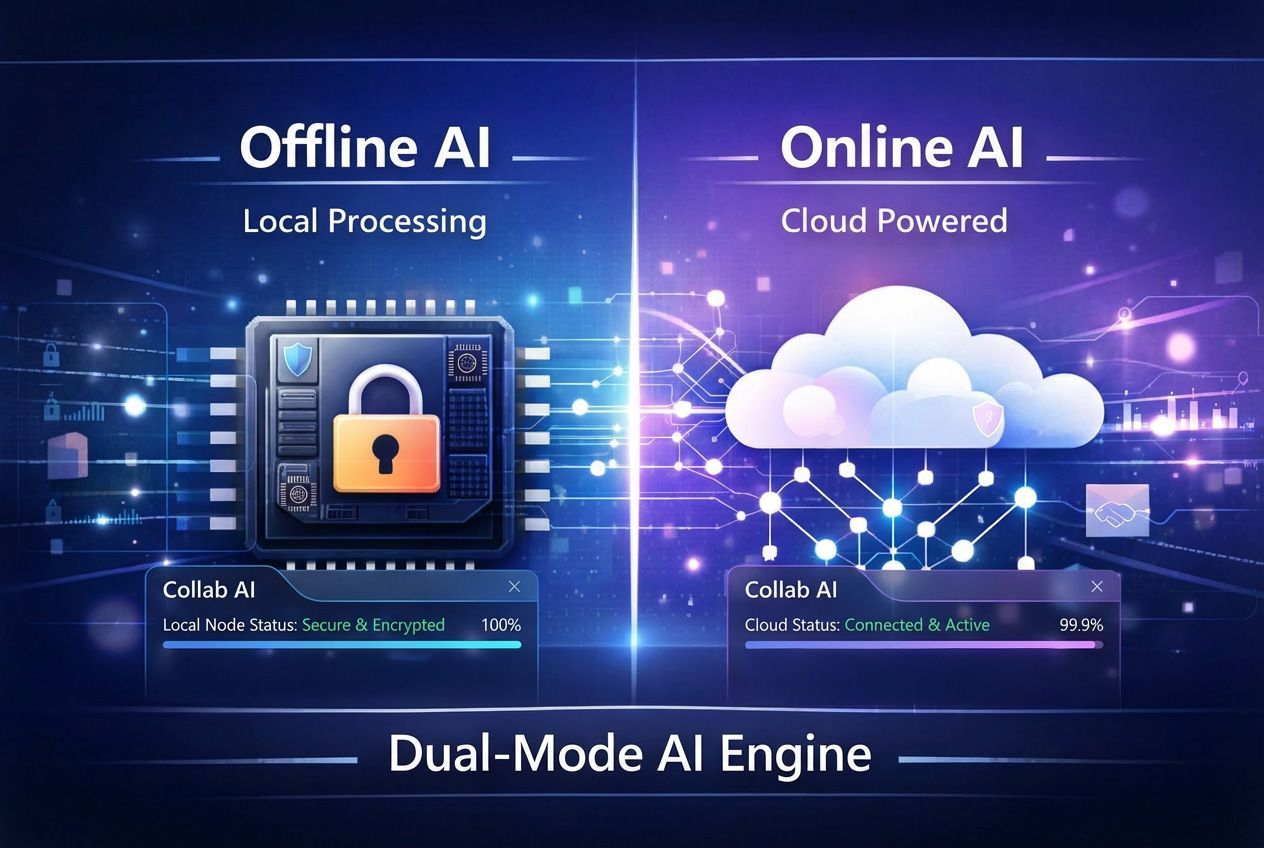
The future of AI is not cloud-only — and it’s not offline-only either. The future is dual-mode AI.
Dual-mode AI allows users to choose:
- Offline AI, running directly on the device for maximum privacy and control.
- Online AI, connecting to cloud-based large language models when deeper reasoning or external knowledge is needed.
This approach reframes AI from a single pipeline into an adaptive system that respects context, sensitivity, and intent.
How Collab Is Built for the AI Privacy Shift
Collab was designed from the ground up to support this new reality.
Dual-Mode AI Engine
Collab enables users to switch seamlessly between:
- Offline AI, which runs locally on the device. Proprietary content, lesson materials, and internal knowledge never leave the hardware.
- Online AI, which can connect to any LLM of the user’s choice — including OpenAI, Anthropic, Claude, or private models — for cloud-scale reasoning and generation.
This gives users choice, not lock-in.
Privacy-First Architecture
Unlike traditional productivity platforms, Collab follows a local-first data model:
- All data is stored locally by default.
- Cloud sync is optional and end-to-end encrypted.
- Users retain full ownership of their work.
- Workspaces can be exported in open formats such as JSON and Markdown.
This architecture aligns naturally with privacy regulations and institutional data policies, making Collab suitable for education, enterprise, and regulated environments.
The New Standard for Intelligent Workspaces
The AI privacy shift signals a fundamental change in expectations. Users no longer want to trade privacy for productivity. They want both.
The next standard of work will be defined by platforms that:
- Integrate AI deeply into workflows
- Offer offline and online intelligence
- Respect data ownership by default
- Operate seamlessly across devices and platforms
Collab represents this next generation: a privacy-first, AI-powered Knowledge Operating System built for how people actually work, teach, and think.